Table of Contents
- How Is Overtime Calculated in UAE Labor Law
- Why Is Accurate Overtime Calculation So Important?
- How Overtime Rules Apply Across Different UAE Industries
- Industries and Employees Exempt from Overtime Provisions
- Employer Compliance Requirements and Payroll Best Practices
- Impact of Overtime on Project Costs and Operational Efficiency
- Common Overtime Calculation Mistakes Employers Should Avoid
- Conclusion
- FAQs
Overview
- Overtime is based on basic salary, not total salary.
- Extra hours are paid at higher rates (25%, 50%, or 150%) depending on timing.
- Employers must track hours properly to stay compliant with UAE Labour Law (MOHRE).
Managing project costs and workforce schedules requires a clear understanding of regional compliance. Under the UAE Labor Law (Federal Decree-Law No. 33 of 2021), overtime rules apply strictly to commercial businesses, contracting firms, and industrial operations.
Incorrect calculations often lead to fines or payroll friction. This guide explains how to calculate overtime accurately, balance your labor budgets, and maintain compliance.
How Is Overtime Calculated in UAE Labor Law
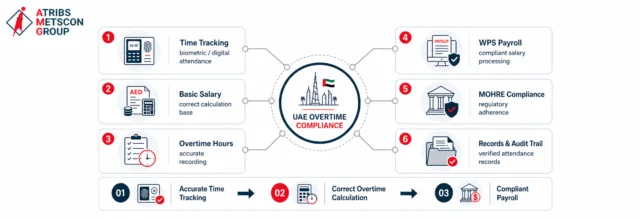
UAE employment frameworks base overtime calculation on an employee’s basic salary rather than their gross package. Allowances for housing, transportation, or utilities are excluded from the baseline hourly calculation.
When a team member exceeds standard hours, employers must apply the precise legal premium specified for that specific shift type. Failing to isolate the basic salary during payroll processing remains a primary cause of non-compliance.
Standard Working Hours Under UAE Labour Law
In almost all commercial sectors, the official working schedule is 8 hours per day, equivalent to 48 hours per week. In the month of Ramadan, there will be a deduction of two hours from the statutory working time. MOHRE allows flexible/compressed working schedules in some sectors only if the number of hours is not above the limit. The excess hours worked fall under overtime.
Overtime Rate Calculation Formula
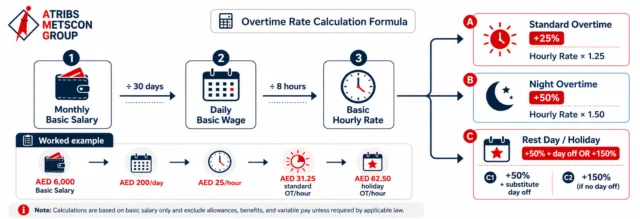
To compute overtime pay, the first step is to determine the standard hourly rate. The formula for computing the standard hourly rate is to divide the monthly basic pay by 30, then divide that result by 8. After computing the hourly rate, compute the overtime rate based on the statutory premium depending on the type of overtime:
- Standard Overtime Rate = Base Hourly Rate + 25% Base Hourly Rate (This refers to overtime work done on ordinary days.)
- Night Overtime Rate = Base Hourly Rate + 50% Base Hourly Rate (This refers to overtime work done from 10:00 PM to 4:00 AM.)
- Rest Day/Holiday Overtime Rate = Base Hourly Rate + 50% Base Hourly Rate, accompanied by one day off compensation, otherwise Base Hourly Rate + 150% Base Hourly Rate.

Hire Globally Without Setting Up a Local Entity

Example of Overtime Calculation in UAE
Consider an operational supervisor with a monthly basic salary of AED 6,000.
- Daily Basic Wage: AED 6,000 / 30 = AED 200 per day.
- Standard Hourly Rate: AED 200 / 8 = AED 25 per hour.
Day Shift Overtime Example
For an employee working 2 hours of standard daytime overtime during a typical week, the 25% premium must be applied. In this case, the overtime pay will be equal to AED 31.25 per hour, since AED 25 x 1.25 equals AED 31.25.
Public Holiday Overtime Example
In case the supervisor renders 8 hours of work during a legal public holiday, the applicable rate of pay should be 150 percent considering that there is no compensation day scheduled. The holiday hourly rate will be AED 62.50 (AED 25 x 2.5). Hence, the holiday pay is AED 500.
Why Is Accurate Overtime Calculation So Important?
Accurate calculation protects organizations from financial penalties and legal operational disruptions. The UAE authorities track wage distributions closely via digital infrastructure. If systematic errors are made in the calculation of the overtime rate, then a fine can be imposed by MOHRE, the corporate bank account may be frozen, or work permit processing might be temporarily suspended.
Other than facing regulatory consequences, accuracy is directly tied to the ability to retain employees. In industries that rely heavily on manpower, such as construction, engineering, and logistics, an open payroll system fosters trust within the organization.
How Overtime Rules Apply Across Different UAE Industries
Shift Work and Extended Project Schedules
Industrial and engineering firms frequently run continuous operations using rotating shift patterns. Managing 24/7 schedules complicates time tracking, especially when handovers overlap or projects enter critical deployment phases. In addition, according to labor laws in the UAE, the total number of working hours should not exceed 144 hours in three weeks regardless of shift work. In such a case, it is necessary for managers to ensure compliance with labor law.
Industries and Employees Exempt from Overtime Provisions
Hire Globally Without Setting Up a Local Entity
Not all personnel qualify for overtime benefits under current labor law. The executive regulations specify clear exemptions based on corporate hierarchy and operational responsibilities:
- Board Members and Executive Management: Executives who have management authority over business operations.
- Department Managers: People who manage an entire department and have high levels of corporate freedom.
- Naval Crews and Sea-Farers: Personnel working under distinct maritime employment frameworks.
Also, effective corporate structures tend to adopt particular models to help simplify administration. It is also important to understand payroll management and assign various roles effectively to help a company determine overtime eligibility and manage compensation accurately.
Employer Compliance Requirements and Payroll Best Practices
Corporate entities must integrate legal standards directly into daily administrative routines. The regulatory landscape leaves no room for manual estimation or informal tracking.
Importance of Accurate Time Tracking Systems
Manual sign-ins or spreadsheets pose many risks in terms of compliance. Today’s businesses operate with advanced biometric or digital clock-in systems. This technology captures accurate times in and out, detecting whether someone works during nights and holidays. Synchronizing your digital clocking system with your primary database will allow you to have accurate hourly computation for your WPS.
Partnering with an experienced what is EOR specialist simplifies these compliance processes for expanding operations. Using professional employer of record services (EOR) ensures your time tracking, contract management, and benefits administration remain aligned with evolving local rules, keeping your business fully protected.
Impact of Overtime on Project Costs and Operational Efficiency
Balancing Productivity and Labor Costs
Overtime serves as a useful tool for meeting tight project deadlines, but excessive reliance on it strains corporate finances. Expensive overtime expenses will reduce the profit margin initially. Tiredness brought about by long working hours may cause some operational errors in addition to posing more safety threats to your staff. Effective management of your labor force would require that you make an analysis of the current state of affairs before expanding your labor force.
UAE Compliance Considerations for Contractors, Engineering Firms, and Industrial Businesses
Contractors and engineering firms operate under strict timelines governed by service-level agreements. When project delays occur, the temptation to expand shift lengths rises. The overtime that is allowed by law is only up to 2 hours a day. Forcing workers to work more than the allowable limit is against MOHRE rules, and will get the company in trouble.
Integrating Compliance into Project Execution Workflows
To ensure there is a balance between complying with the rules and completing projects in time, it is important for project managers to include labor limitations as part of their scheduling program. The project schedule must allow time for normal working hours, holiday schedules, and even rest days at the outset.
Common Overtime Calculation Mistakes Employers Should Avoid
Many organizations face legal challenges due to avoidable payroll errors. Identifying and fixing these systemic oversights protects your business from unnecessary liabilities:
- Calculating Overtime Using Gross Salary: Including housing or transport allowances in the calculation baseline artificially inflates payroll costs.
- Misclassification of Exempt Employees: The designation of administrative or technical employees as “managers” to evade paying any overtime is illegal.
- Failure to Account for Overtime for Night Work: Failure to include the necessary 50% premium on any work done between 10:00 PM and 4:00 AM.
- Averaging Hours Across Months: Tracking hours over a monthly period to offset busy weeks against slower weeks is illegal; calculations must follow a strict weekly cycle.
- Neglecting Comprehensive Records: Failing to retain verified time-attendance sheets for the legally required period leaves the firm vulnerable during regulatory audits.
Conclusion
It is important to understand the way overtime pay is calculated by UAE labor law in order to ensure seamless corporate operations and compliance. It is crucial to coordinate hard deadline projects and labor limitations imposed by the UAE in order to plan ahead and manage payrolls effectively.
If you require short-term manpower for your projects or if you need recruitment services, proper selection of manpower will allow you to increase the efficiency of the workforce. By adhering to the local requirements, you ensure that you do not incur any unnecessary financial burdens on your company.
FAQs
Is overtime pay mandatory under UAE Labour Law?
Yes. Statutory overtime payment is necessary on every occasion when the work exceeds normal working hours of a worker unless he/she falls into one of the exempted categories.
Are construction workers entitled to overtime pay in the UAE?
Yes. Workers of construction, engineering, and industries sites enjoy full legal coverage of the law and must be paid proper compensation for long hours.
Can employers require employees to work overtime?
Yes, an employer may require overtime in order to meet his operational demands, but it should not exceed 2 hours daily except under certain emergencies.
Do employers need to maintain records of overtime hours worked?
Yes. Time attendance sheets must be maintained in order to prove compliance at inspection visits by officials from the Ministry.
Can inaccurate overtime calculations result in labor disputes?
Yes. The systematic practice of underpayment and computational errors is the common cause for employee complaints filed to MOHRE.